Wholesale Pricing Calculator: Free Tool + Tiered Price Sheet


To calculate a wholesale price, divide your landed unit cost by one minus your target margin. A $12.00 unit cost at a 50% target margin gives 12 / 0.50 = $24.00 wholesale, which supports a $48.00 suggested retail price and leaves the retailer a 50% margin of their own. Most Shopify brands land between 45% and 55% wholesale margin, then discount 5% to 15% at higher volume tiers. Use the free wholesale pricing calculator below to enter your cost, target margin and tier discounts, and it returns a complete wholesale pricing sheet: a base price, two volume tier prices, the margin you keep at each tier, and a suggested retail price.
Key takeaways
- Wholesale price = landed unit cost / (1 - target margin). Landed cost includes freight, duty and packaging, not just the factory invoice.
- Most Shopify brands sit between 45% and 55% wholesale margin, with food and beverage lower and beauty higher.
- Markup and margin are not the same number: a 100% markup is a 50% margin, and confusing them costs about 17 points.
- Set tier breaks off your case pack, not round numbers, so buyers never have to order a broken case.
- A price sheet that lives in your store beats a PDF, because it never goes stale and buyers can self serve.
In this article
- The wholesale pricing calculator
- How do you calculate a wholesale price?
- What margin should you build into a wholesale price?
- How do you turn one price into a wholesale pricing sheet?
- Markup or margin: which one should the calculator use?
- How do you get the sheet in front of buyers?
- FAQ
The wholesale pricing calculator
Enter your landed unit cost and the margin you want to keep. The calculator returns your base wholesale price, two volume tiers, the margin you keep at each one, and a suggested retail price. Nothing is sent anywhere, and the numbers update as you type.
How do you calculate a wholesale price?
The wholesale price formula is one line:
Wholesale price = unit cost / (1 - target margin)
Unit cost is your landed cost, not your invoice cost. Landed cost means the product itself plus freight, duty, packaging, and any per unit fulfilment or pick and pack fee you pay before the carton leaves your warehouse. Brands that price off the factory invoice alone routinely find their real margin is 8 to 12 points lower than the spreadsheet said.
Work the default example through by hand. A $12.00 landed cost at a 50% target margin gives 12 / 0.50, which is $24.00. You keep $12.00 a unit. Double that for a $48.00 suggested retail price, and the retailer keeps $24.00, which is a 50% margin for them too. That symmetry is the reason the 50% wholesale, 2x retail pairing became the default across so many consumer categories.
If you want the formula pulled apart in more depth, including how to treat returns, samples and freight allowances, read our full guide to what wholesale price is and how to calculate it.
What margin should you build into a wholesale price?
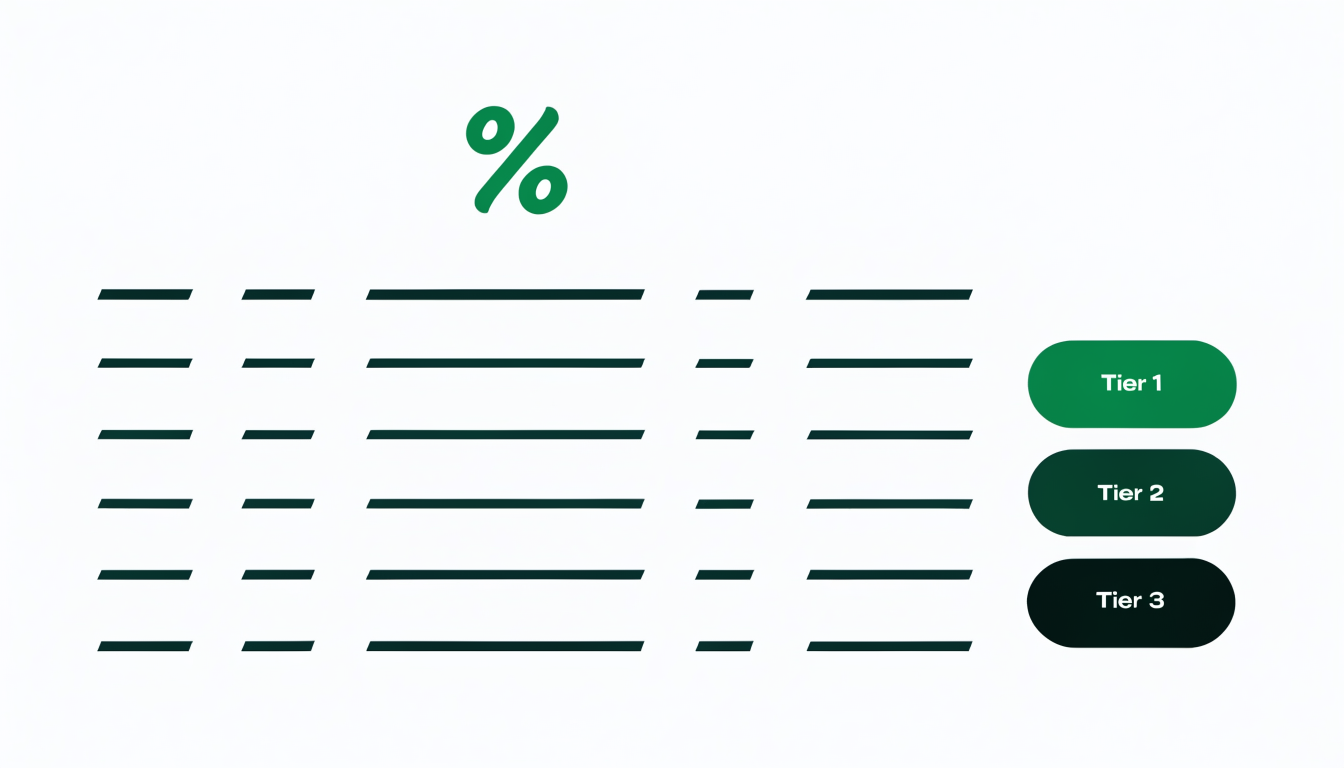
Most Shopify brands selling into independent retail land between 45% and 55% wholesale margin. The exact number is set by three things: how much of your cost is fixed, how much service the retailer expects, and what the category has trained buyers to expect.
- Apparel and accessories: usually 50% to 55%, because returns, size curves and seasonal markdown all sit on your side of the ledger.
- Food and beverage: often 35% to 45%, since case costs are low, reorders are frequent and shelf life limits how much anyone will hold.
- Beauty and personal care: commonly 55% to 65%, because unit costs are small relative to retail and testers, samples and merchandising are expected.
- Home goods and furniture: often 45% to 50%, where freight is heavy and the retailer carries real inventory risk.
Sanity check the result before you publish it. If your calculated wholesale price sits above what the retailer can double and still sell, the margin is too high and the line will not move. If it sits so low that a 10% volume discount wipes out your contribution, you have no room to negotiate. The U.S. Small Business Administration makes the same point in its guidance on marketing and sales: pricing is a strategy decision, not an arithmetic one, and it has to survive contact with the channel.
How do you turn one price into a wholesale pricing sheet?
A single wholesale price is a starting point, not a price sheet. A wholesale pricing sheet gives a buyer the unit price at every quantity they might realistically order, so they can size the purchase order themselves instead of emailing you to ask. That one change removes most of the back and forth in a first order.
Build the tiers off your case pack rather than round numbers. If you ship in packs of 12, breaks at 12, 48 and 120 map onto how the buyer actually orders. Breaks at 10, 50 and 100 force them to do maths that ends in a broken case.
The verdict on flat pricing versus a tiered sheet is one sided for anyone selling to more than a handful of accounts: a tiered sheet wins on order size, on negotiation and on admin, and only loses on how long it takes to set up once.
Read the rows that decide it. A tiered sheet rewards a larger purchase order, so the buyer has a reason to move from a 12 unit trial to a 48 unit reorder, and you capture that without a phone call. It also gives you somewhere to go in a negotiation: you concede a tier rather than cutting the base price you quote every other account. A flat price has neither, and its only real advantage is that you can publish it in a few minutes. The one row where a flat price genuinely wins is setup, and it wins that once. For how to build the tiers themselves, see our walkthrough on setting up tiered wholesale pricing on Shopify, and on picking the break points, our guide to minimum order quantity.
Markup or margin: which one should the calculator use?
This is where most pricing spreadsheets quietly go wrong. Markup and margin describe the same gap between cost and price, but they divide it by different numbers. Markup is the spread over cost, calculated as (price - cost) / cost. Margin is the spread as a share of the price you charge, or (price - cost) / price.
A 100% markup is a 50% margin. A 50% markup is only a 33.3% margin. If you tell your team to 'add 50%' and they mean markup while you meant margin, every price on the sheet lands about 17 points light, and you will not notice until the quarter closes.
The calculator above takes margin as the input, because margin is what your P&L reports and what you need to protect, and it shows the equivalent markup underneath so you can quote either one. The related question of what multiple the retailer applies on top is keystone pricing, which is the 2x default in the retail multiple field.
How do you get the sheet in front of buyers?
A price sheet in a PDF is a price sheet you will maintain forever. Every cost change means a new export, a new email, and at least one account still ordering off last season's numbers. The alternative is to put the tiers into the store itself, so the logged in buyer sees their price on the product page and the correct total at checkout.
On Shopify that means three things working together: customer groups so each account sees its own tier, quantity breaks so the price steps down at the break points you set, and a minimum order quantity so nobody checks out with a broken case. PortalSphere does all three natively, gates the catalog behind a registration form so retail shoppers never see wholesale pricing, and adds net terms and tax exemption for the accounts that need them.
If you are still deciding how the whole channel should be structured before you get to price sheets, start with our wholesale pricing strategy guide, which covers the six models and where each one breaks down.
Frequently asked questions
What is the formula for wholesale price?
Wholesale price = unit cost / (1 - target margin). A $12.00 landed cost at a 50% target margin gives 12 / 0.50 = $24.00. Use landed cost, which includes freight, duty and packaging, rather than the factory invoice price.
Is wholesale price usually half of retail?
It is the most common convention, but it is a convention rather than a rule. Doubling wholesale to reach retail, known as keystone pricing, gives the retailer a 50% margin. Categories with high service costs or slow turns often price at 2.2x to 2.5x instead, and fast moving consumables sometimes sit closer to 1.8x.
What is a wholesale pricing sheet?
A wholesale pricing sheet lists your unit price at each order quantity tier, alongside the case pack or minimum order quantity for each item. A good one lets a buyer size their own purchase order without contacting you. The calculator on this page generates a three tier sheet from your cost and target margin.
How much should I discount at higher volume tiers?
Most brands discount 5% at the second tier and 10% to 15% at the third. Check each tier against the margin column in the calculator: if the deepest tier drops you below roughly 35% margin, the volume has to be genuinely incremental to be worth it, not just the same account consolidating orders it would have placed anyway.
Can I charge different wholesale prices to different customers?
Yes, and most brands eventually do, typically separating distributors, key accounts and independent stockists. On Shopify this needs customer group pricing rather than a single discount code. PortalSphere assigns each account to a group and applies that group's tiers automatically at login and at checkout.
Put your price sheet inside your store
PortalSphere applies your wholesale tiers per customer group on Shopify, with MOQs, gated pricing and net terms built in.