Minimum Order Quantity (MOQ): Definition and How to Set One

A minimum order quantity (MOQ) is the smallest order a supplier will accept, measured in units, in order value, or in fixed case packs. Suppliers set MOQs so that each order clears the fixed cost of processing and shipping it, and so wholesale pricing stays tied to volume. To calculate one, divide the fixed cost of handling an order by your contribution margin per unit to find the break-even quantity, add a profit floor, then round up to your case pack. There is no universal number: apparel brands commonly sit at 24 to 50 units per style, while contract manufacturers often start at 500 or more. An MOQ only does its job if it is enforced at checkout rather than checked by hand after the order arrives.
Key takeaways
- MOQ stands for minimum order quantity: the smallest order a supplier will accept, set by unit count, order value, or case pack.
- Suppliers set MOQs to cover the fixed cost of processing an order, make production runs viable, and keep wholesale pricing tied to volume.
- Calculate yours by dividing order-processing cost by contribution margin per unit, then adding a profit floor and rounding up to your pack size.
- Set it too high and you lose small independent retailers; tiered minimums by customer group are the usual fix.
- An MOQ enforced at the cart stops undersized orders before they become email exceptions.
What does MOQ stand for, and what is a minimum order quantity?
MOQ stands for minimum order quantity. It is the smallest amount a supplier will sell in a single order, and it is set by the seller, not the buyer. You will also see it written as minimum ordering quantity, and in manufacturing it usually refers to the smallest production run a factory will accept.
An MOQ can be expressed three ways:
- By units. "24 units per style" or "100 pieces per order."
- By value. A minimum order value (MOV), such as $500 per purchase order. Some suppliers use both, so an order has to clear the unit floor and the dollar floor.
- By pack. A case pack or pack size, where products only ship in fixed multiples: a case of 12, a pallet of 480. The pack size becomes the practical MOQ.
MOQs exist because of simple arithmetic. Every order carries fixed costs that do not shrink when the order does: picking, packing, invoicing, a freight booking, time spent chasing payment. Below a certain size, an order costs more to fulfill than it earns.
Why do suppliers set minimum order quantities?
Four reasons come up again and again, and they apply whether you are a factory in Guangdong or a candle brand shipping to 60 boutiques.
- To cover the fixed cost of an order. Processing, packing, and shipping cost roughly the same for 6 units as for 60. An MOQ makes sure the margin on the order clears that cost.
- To make production runs viable. Manufacturers amortize setup: dies, screens, machine changeovers, material minimums. A short run spreads that setup cost over too few units.
- To protect wholesale pricing. If a buyer can take three units at wholesale, wholesale becomes retail with a discount attached. An MOQ is what keeps the two channels honest.
- To keep inventory moving predictably. Larger, less frequent orders are easier to forecast and cheaper to hold than a constant trickle of tiny ones.
NetSuite's breakdown of MOQ types and trade-offs makes the same point from the inventory side: the minimum exists to keep each transaction above the break-even line, not to squeeze buyers.

How do you calculate a minimum order quantity?
There is no single MOQ formula, because the right number depends on your margin and your cost to serve an order. What works is a four-step calculation you can run per product in about ten minutes.
1. Find your contribution margin per unit. Wholesale price minus the landed cost to make or buy the unit. Say you sell a unit at $12 and it costs you $5, giving $7 per unit.
2. Add up the fixed cost of processing one order. Pick and pack labor, packaging, the freight booking, invoicing, payment chasing. If that comes to $85, that is what every order has to cover before it earns anything.
3. Find the break-even quantity. Divide fixed cost by contribution margin: $85 divided by $7 is 12.1 units. At 13 units the order stops losing money.
4. Set a profit floor, then round to your pack size. Break-even is not a target. If you want at least $150 of contribution per order, that is $150 divided by $7, or 22 units. Round up to your case pack of 12 and your MOQ becomes 24 units, two cases.
Buyers can run the same math in reverse, swapping order-processing cost for holding cost and expected sell-through, to judge whether a supplier's MOQ is one they can absorb.
What is a good MOQ, and what happens if you set it too high?
There is no standard MOQ. In apparel, 24 to 50 units per style is common. In food and beverage, a case or two. Contract manufacturers frequently start at 500 or 1,000 units because of setup costs. The right number is the one that clears your break-even with room to spare and still fits what a realistic first order looks like for your buyers.
The risk sits on both sides. Set the MOQ too low and you spend Tuesday morning packing a $90 order that costs you $85 to ship. Set it too high and you lose the small independent retailer who would have reordered monthly for three years. A common fix is a tiered MOQ: a low opening order to get a new account in the door, with a higher threshold on reorders once they know the product sells. Another is pairing the MOQ with volume discounts and quantity breaks, so the minimum is a floor and the discount ladder is the reason to go above it.
How do you enforce an MOQ once you have set it?
A minimum order quantity only works if the buyer runs into it at the moment they place the order. If it lives in a PDF line sheet and gets checked by a human afterwards, you are not enforcing an MOQ, you are handling exceptions.
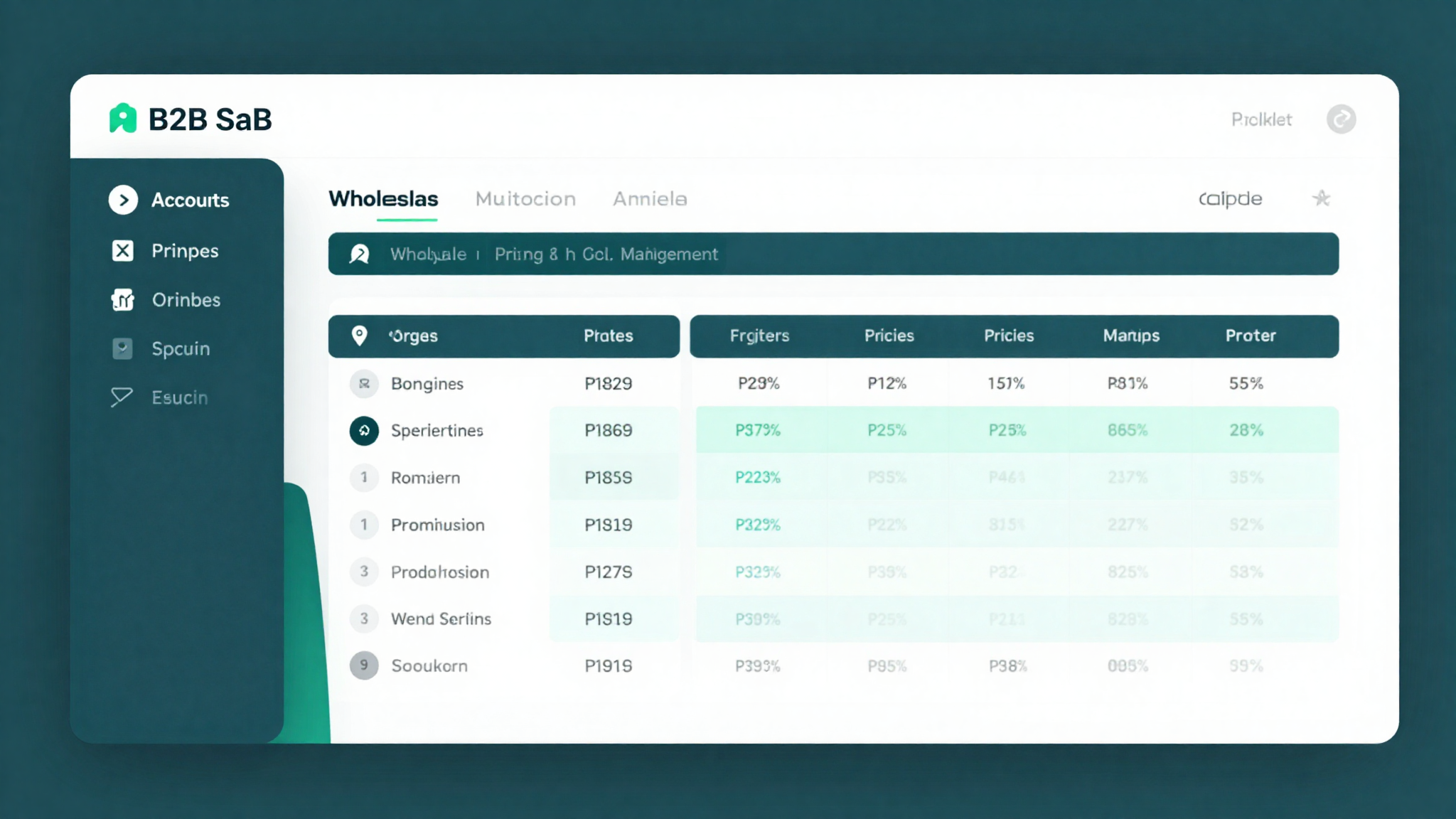
The honest comparison is between running wholesale on spreadsheets and email versus running it through a gated B2B portal on your store. The portal wins on enforcement because the rule is applied at the cart, per customer group, before the order can be submitted.
Here is what those rows mean in practice. With spreadsheets and email, a minimum order quantity is a sentence in a document, so every undersized order becomes a back-and-forth that delays the shipment and costs you goodwill with a new account. In a B2B portal, PortalSphere applies the minimum at the cart for the customer group the buyer belongs to, so a boutique on a 24-unit minimum simply cannot submit 18, and a distributor on a 240-unit minimum sees their own number instead. Case packs work the same way: if a product ships in twelves, the quantity field moves in twelves, which removes the most common source of short-ship disputes. And because the volume discount ladder sits alongside the minimum, the buyer sees what the next price break is worth while they are still building the order.
For the step-by-step Shopify setup, including customer groups and per-product rules, see our walkthrough on how to set minimum order quantities on Shopify wholesale.
How do buyers negotiate a lower minimum order quantity?
An MOQ is usually more flexible than the line sheet suggests, because the supplier's real constraint is the economics of the order, not the number itself. Four approaches work:
- Pay more per unit. Take half the MOQ at a smaller discount, handing back the margin the volume was meant to create.
- Commit across SKUs. Many suppliers will apply the minimum across an assortment rather than per style.
- Commit over time. A standing order of 20 units a month is worth more than one order of 60, and it smooths their production schedule.
- Ask about overruns and stock. Factories often hold surplus from other runs that they will release below the normal MOQ.
What rarely works is asking for an exception with nothing offered in return. The supplier already ran the break-even math, and below it they are paying for the privilege of your order.
Frequently asked questions
What does MOQ stand for?
MOQ stands for minimum order quantity: the smallest number of units, or the smallest order value, a supplier will accept in a single order. It is set by the seller and is most common in wholesale, B2B and manufacturing.
What is the difference between MOQ and MOV?
MOQ is a floor measured in units, such as 24 pieces per style. MOV is a minimum order value measured in currency, such as $500 per order. Many wholesale brands use both, so a purchase order has to satisfy the unit minimum and the dollar minimum before it can be submitted.
How do you calculate a minimum order quantity?
Divide the fixed cost of processing one order by your contribution margin per unit to get the break-even quantity, then add a profit floor and round up to your case pack. If processing costs $85, margin is $7 a unit, and you want $150 of contribution per order, the math gives 22 units, which rounds to 24 on a case pack of 12.
What is a good MOQ for wholesale?
There is no universal number. Apparel brands commonly sit at 24 to 50 units per style, food and beverage brands at one or two cases, and contract manufacturers often start at 500 to 1,000 units because of production setup costs. A good MOQ clears your break-even with margin to spare and still matches a realistic first order for the buyers you want.
Can you set a different MOQ for each customer?
Yes. Tiered minimums by customer group are standard practice: a lower opening minimum for new independent retailers, a higher one for distributors buying at a deeper discount. Enforcing that by hand is where it breaks down, which is why the rule belongs in the ordering system rather than in a PDF.
Do minimum order quantities apply to retail customers?
Normally no. MOQs are a wholesale and B2B mechanism. If you sell both retail and wholesale from one store, the minimum should apply only to the gated wholesale side, which means your store needs to tell the two customer types apart before the cart rules run.
Enforce your MOQs where buyers actually see them
PortalSphere applies minimum order quantities, case packs and volume discounts per customer group on your Shopify store, at the cart, before an order can be submitted.